



Array
(
    [0] => 18335
    [1] => 6435
    [2] => 4864
    [3] => 5004
    [4] => 5087
    [5] => 5338
)

A test in the north of France for PAOK

PAOK will face Lille (officially known as Lille Olympique Sporting Club), a traditional force in French football that finished in fifth place last season, on Matchday 3 of the League Phase of the Europa League. The match takes place at the imposing Stadium Pierre Mauroy on Thursday 23.10 at 22:00.

23.10.2025
  • Lille’s trophy cabinet is adorned with five French championships (1946, 1954, 2011, 2021), six Coupes (1946, 1947, 1948, 1953, 1955, 2011) and one French Super Cup (2021).
  • Last season, they finished in fifth place and tied with Nice, falling behind on goal difference, which is why they are competing in the League Phase of this year’s Europa League.
  • In last season’s Champions League, they were the surprise of the League Phase, as they finished seventh, with just two defeats (to Sporting Lisbon and Liverpool).
  • The club was founded in 1944 after the merger of two local teams, Olympique Lille and Fès, which were founded in 1901 and 1902, respectively. The team’s colors are blue and red.
  • Their golden age is considered to be from 1940 to 1955, as the team experienced unprecedented success immediately after its foundation. With coach Georges Heylens and legendary players such as Jean Baratte and Marcel Adamczyk, they won two French championships (1946, 1954) and five Cups (1946, 1947, 1948, 1953, 1955) in one decade.
  • From the 1960s onwards, the club was plagued by financial problems, relegations and uncertainty. It gradually returned with administrative stability and development in its academies.
  • From 1997 to 2000, Lille played in France’s second division (Ligue 2), but in 2000 they were promoted to Ligue 1, managing to compete in the Champions League in 2002, 2005 and 2006.
  • In 2004, they won the Intertoto Cup, and in the 2004–05 season they finished second in the French championship.
  • On 2 November 2005, they eliminated Manchester United from the Champions League and the following year they beat Milan 2–0.
  • In the 2010–11 season, under coach Rudi Garcia and with stars such as Eden Hazard, Gervinho and Moussa Sow, Lille won the double.
  • Ten years later, in 2020–21, Christophe Galtier led Lille to the top of Ligue 1 again, against the “giants” Paris Saint-Germain and Lyon. Lille started strongly and remained undefeated away from home for almost the entire season. In the final stretch, they withstood the pressure from Paris and secured the title on the last matchday (23 May 2021), defeating Angers 2–1 away from home. They won the championship with 83 points, compared to Paris’ 82.

Stadium Pierre Mauroy

Lille’s five-star Stadium Pierre Mauroy is an impressive multi-purpose stadium with a retractable roof in the city of Villeneuve-d’Ascq in northern France, near Lille. With a capacity of 50,186 seats, it is the fourth largest sports stadium in France.

  • Originally called Grand Stade Lille Métropole, it was renamed on 21 June 2013, following the death of former mayor of Lille (for 28 years) and former Prime Minister of France Pierre Mauroy.
  • The total cost of the project was €618 million, including €282 million for the stadium, €42 million for additional development such as parking spaces, hotels and restaurants, and €96 million to ensure that seismic standards were met.
  • The cost of the project caused considerable controversy, and there were no few appeals against its construction.
  • The construction of a new stadium in Lille was decided after the failure of the reconstruction of the old Stade Grimonprez-Jooris, the height of which would have exceeded the permitted limit due to its proximity to the Lille fortress.
  • The two-level Pierre Mauroy is 31m high, with a total capacity of 50,186 seats, including 4,965 official seats, 1,842 luxury seats in suites, 448 VIP and 326 press seats.
  • It has a retractable roof that opens and closes in 15 minutes.
  • It is equipped with two windmills and a photovoltaic installation for energy production.
  • Within three hours, a part of the stadium is transformed into a basketball court with a capacity of 27,000 seats. This part is hydraulically raised and creates a lower level with seats. Its capacity can be changed, so that in addition to basketball matches, it can host handball, tennis, performances, etc.
  • The stadium is fully accessible from metro stations and roads and includes 7,000 parking spaces.
  • The attendance record is 49,712 spectators, who watched Lille’s 5–1 victory over Paris Saint-Germain in 2019.
  • On 17.11.2012, the French national team faced Argentina in the first rugby match on French soil with a covered roof.
  • Lille played its first match in its new stadium on 17 August 2012 against Nancy.
  • When it was inaugurated, it was the third largest stadium in France, after the Stade de France and the Velodrome. It is now the fourth largest.
  • The stadium is owned by the Eiffage group until 2043, when the stadium will become the property of the Lille metropolitan area.
  • It hosted EURO 2016 matches, Eurobasket 2015, basketball and handball matches of the 2024 Olympics, the 2023 Rugby World Cup and the Davis Cup (2014, 2017, 2018).

The elegant and cosmopolitan Lille

A cosmopolitan and artistic city, with an aura of culture and charm of Western Europe, Lille combines beauty and nobility, offers art and history, as well as fine wines along with gastronomic delights. It is just one hour from Paris, half an hour from Brussels, and one and a half hours from London. It has always been a strategic point in Europe, hence during the Middle Ages and the French Revolution it became known as the city of France that was besieged the most times.

  • It is the fourth largest city in France (after Paris, Lyon and Marseille) with a population of approximately 230,000 inhabitants. The wider metropolitan area exceeds 1.1 million inhabitants.
  • Lille was named after the island on which it was founded (in French L’Isle).
  • Historically it is a Flemish city, although the spoken language has always been Latin.
  • Since its founding, it has had a commercial character. The Industrial Revolution transformed it into a major industrial capital, centered on the mechanical and textile industries.
  • The Palais des Beaux Arts museum has a wealth of artistic treasures, from Renaissance works to works by Toulouse Lautrec and Goya. It was founded by Napoleon in the 19th century.
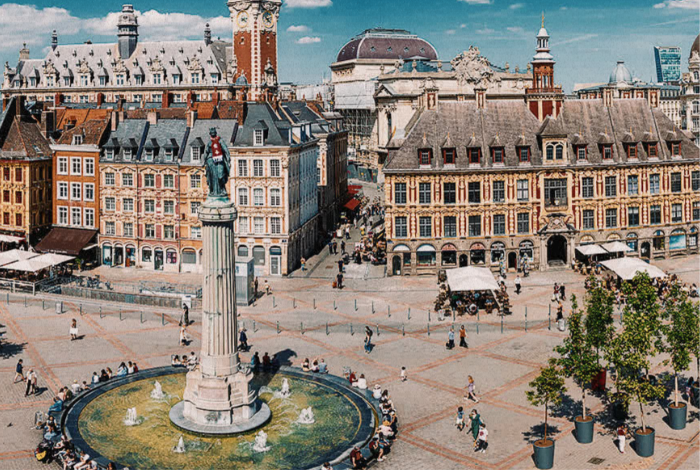
  • The central Charles de Gaulle Square, in the beautiful old town of Lille (the former president of France was born and raised in Lille) is bustling with bistros and cafés.
  • The city’s old stock exchange (La Vieille Bourse) is located in a complex of arcades, with a wonderful inner courtyard, built in the 17th century. It is home to bookstores with rare books and shops with collectibles.
  • The Lille Opera House is one of the most beautiful baroque buildings in the city. It was built in the early years of the 20th century.
  • The GrandeBraderie is the largest open-air market in France. Its stalls are about 10,000! It is held once a year, on the first weekend of September, and attracts visitors from all over Europe.
  • More than 100,000 students study at the University of Lille. It is recognized worldwide for its excellence in research and the quality of its teaching and is ranked among the top institutions in France and Europe.
  • It was the European Capital of Culture in 2004, along with Genoa.

Relevant News

A test in the north of France for PAOK

PAOK will face Lille (officially known as Lille Olympique Sporting Club), a traditional force in French football that finished in fifth place last season, on Matchday 3 of the League Phase of the Europa League. The match takes place at the imposing Stadium Pierre Mauroy on Thursday 23.10 at 22:00.

23.10.2025
  • Lille’s trophy cabinet is adorned with five French championships (1946, 1954, 2011, 2021), six Coupes (1946, 1947, 1948, 1953, 1955, 2011) and one French Super Cup (2021).
  • Last season, they finished in fifth place and tied with Nice, falling behind on goal difference, which is why they are competing in the League Phase of this year’s Europa League.
  • In last season’s Champions League, they were the surprise of the League Phase, as they finished seventh, with just two defeats (to Sporting Lisbon and Liverpool).
  • The club was founded in 1944 after the merger of two local teams, Olympique Lille and Fès, which were founded in 1901 and 1902, respectively. The team’s colors are blue and red.
  • Their golden age is considered to be from 1940 to 1955, as the team experienced unprecedented success immediately after its foundation. With coach Georges Heylens and legendary players such as Jean Baratte and Marcel Adamczyk, they won two French championships (1946, 1954) and five Cups (1946, 1947, 1948, 1953, 1955) in one decade.
  • From the 1960s onwards, the club was plagued by financial problems, relegations and uncertainty. It gradually returned with administrative stability and development in its academies.
  • From 1997 to 2000, Lille played in France’s second division (Ligue 2), but in 2000 they were promoted to Ligue 1, managing to compete in the Champions League in 2002, 2005 and 2006.
  • In 2004, they won the Intertoto Cup, and in the 2004–05 season they finished second in the French championship.
  • On 2 November 2005, they eliminated Manchester United from the Champions League and the following year they beat Milan 2–0.
  • In the 2010–11 season, under coach Rudi Garcia and with stars such as Eden Hazard, Gervinho and Moussa Sow, Lille won the double.
  • Ten years later, in 2020–21, Christophe Galtier led Lille to the top of Ligue 1 again, against the “giants” Paris Saint-Germain and Lyon. Lille started strongly and remained undefeated away from home for almost the entire season. In the final stretch, they withstood the pressure from Paris and secured the title on the last matchday (23 May 2021), defeating Angers 2–1 away from home. They won the championship with 83 points, compared to Paris’ 82.

Stadium Pierre Mauroy

Lille’s five-star Stadium Pierre Mauroy is an impressive multi-purpose stadium with a retractable roof in the city of Villeneuve-d’Ascq in northern France, near Lille. With a capacity of 50,186 seats, it is the fourth largest sports stadium in France.

  • Originally called Grand Stade Lille Métropole, it was renamed on 21 June 2013, following the death of former mayor of Lille (for 28 years) and former Prime Minister of France Pierre Mauroy.
  • The total cost of the project was €618 million, including €282 million for the stadium, €42 million for additional development such as parking spaces, hotels and restaurants, and €96 million to ensure that seismic standards were met.
  • The cost of the project caused considerable controversy, and there were no few appeals against its construction.
  • The construction of a new stadium in Lille was decided after the failure of the reconstruction of the old Stade Grimonprez-Jooris, the height of which would have exceeded the permitted limit due to its proximity to the Lille fortress.
  • The two-level Pierre Mauroy is 31m high, with a total capacity of 50,186 seats, including 4,965 official seats, 1,842 luxury seats in suites, 448 VIP and 326 press seats.
  • It has a retractable roof that opens and closes in 15 minutes.
  • It is equipped with two windmills and a photovoltaic installation for energy production.
  • Within three hours, a part of the stadium is transformed into a basketball court with a capacity of 27,000 seats. This part is hydraulically raised and creates a lower level with seats. Its capacity can be changed, so that in addition to basketball matches, it can host handball, tennis, performances, etc.
  • The stadium is fully accessible from metro stations and roads and includes 7,000 parking spaces.
  • The attendance record is 49,712 spectators, who watched Lille’s 5–1 victory over Paris Saint-Germain in 2019.
  • On 17.11.2012, the French national team faced Argentina in the first rugby match on French soil with a covered roof.
  • Lille played its first match in its new stadium on 17 August 2012 against Nancy.
  • When it was inaugurated, it was the third largest stadium in France, after the Stade de France and the Velodrome. It is now the fourth largest.
  • The stadium is owned by the Eiffage group until 2043, when the stadium will become the property of the Lille metropolitan area.
  • It hosted EURO 2016 matches, Eurobasket 2015, basketball and handball matches of the 2024 Olympics, the 2023 Rugby World Cup and the Davis Cup (2014, 2017, 2018).

The elegant and cosmopolitan Lille

A cosmopolitan and artistic city, with an aura of culture and charm of Western Europe, Lille combines beauty and nobility, offers art and history, as well as fine wines along with gastronomic delights. It is just one hour from Paris, half an hour from Brussels, and one and a half hours from London. It has always been a strategic point in Europe, hence during the Middle Ages and the French Revolution it became known as the city of France that was besieged the most times.

  • It is the fourth largest city in France (after Paris, Lyon and Marseille) with a population of approximately 230,000 inhabitants. The wider metropolitan area exceeds 1.1 million inhabitants.
  • Lille was named after the island on which it was founded (in French L’Isle).
  • Historically it is a Flemish city, although the spoken language has always been Latin.
  • Since its founding, it has had a commercial character. The Industrial Revolution transformed it into a major industrial capital, centered on the mechanical and textile industries.
  • The Palais des Beaux Arts museum has a wealth of artistic treasures, from Renaissance works to works by Toulouse Lautrec and Goya. It was founded by Napoleon in the 19th century.
  • The central Charles de Gaulle Square, in the beautiful old town of Lille (the former president of France was born and raised in Lille) is bustling with bistros and cafés.
  • The city’s old stock exchange (La Vieille Bourse) is located in a complex of arcades, with a wonderful inner courtyard, built in the 17th century. It is home to bookstores with rare books and shops with collectibles.
  • The Lille Opera House is one of the most beautiful baroque buildings in the city. It was built in the early years of the 20th century.
  • The GrandeBraderie is the largest open-air market in France. Its stalls are about 10,000! It is held once a year, on the first weekend of September, and attracts visitors from all over Europe.
  • More than 100,000 students study at the University of Lille. It is recognized worldwide for its excellence in research and the quality of its teaching and is ranked among the top institutions in France and Europe.
  • It was the European Capital of Culture in 2004, along with Genoa.

Relevant News

A test in the north of France for PAOK

PAOK will face Lille (officially known as Lille Olympique Sporting Club), a traditional force in French football that finished in fifth place last season, on Matchday 3 of the League Phase of the Europa League. The match takes place at the imposing Stadium Pierre Mauroy on Thursday 23.10 at 22:00.

23.10.2025
  • Lille’s trophy cabinet is adorned with five French championships (1946, 1954, 2011, 2021), six Coupes (1946, 1947, 1948, 1953, 1955, 2011) and one French Super Cup (2021).
  • Last season, they finished in fifth place and tied with Nice, falling behind on goal difference, which is why they are competing in the League Phase of this year’s Europa League.
  • In last season’s Champions League, they were the surprise of the League Phase, as they finished seventh, with just two defeats (to Sporting Lisbon and Liverpool).
  • The club was founded in 1944 after the merger of two local teams, Olympique Lille and Fès, which were founded in 1901 and 1902, respectively. The team’s colors are blue and red.
  • Their golden age is considered to be from 1940 to 1955, as the team experienced unprecedented success immediately after its foundation. With coach Georges Heylens and legendary players such as Jean Baratte and Marcel Adamczyk, they won two French championships (1946, 1954) and five Cups (1946, 1947, 1948, 1953, 1955) in one decade.
  • From the 1960s onwards, the club was plagued by financial problems, relegations and uncertainty. It gradually returned with administrative stability and development in its academies.
  • From 1997 to 2000, Lille played in France’s second division (Ligue 2), but in 2000 they were promoted to Ligue 1, managing to compete in the Champions League in 2002, 2005 and 2006.
  • In 2004, they won the Intertoto Cup, and in the 2004–05 season they finished second in the French championship.
  • On 2 November 2005, they eliminated Manchester United from the Champions League and the following year they beat Milan 2–0.
  • In the 2010–11 season, under coach Rudi Garcia and with stars such as Eden Hazard, Gervinho and Moussa Sow, Lille won the double.
  • Ten years later, in 2020–21, Christophe Galtier led Lille to the top of Ligue 1 again, against the “giants” Paris Saint-Germain and Lyon. Lille started strongly and remained undefeated away from home for almost the entire season. In the final stretch, they withstood the pressure from Paris and secured the title on the last matchday (23 May 2021), defeating Angers 2–1 away from home. They won the championship with 83 points, compared to Paris’ 82.

Stadium Pierre Mauroy

Lille’s five-star Stadium Pierre Mauroy is an impressive multi-purpose stadium with a retractable roof in the city of Villeneuve-d’Ascq in northern France, near Lille. With a capacity of 50,186 seats, it is the fourth largest sports stadium in France.

  • Originally called Grand Stade Lille Métropole, it was renamed on 21 June 2013, following the death of former mayor of Lille (for 28 years) and former Prime Minister of France Pierre Mauroy.
  • The total cost of the project was €618 million, including €282 million for the stadium, €42 million for additional development such as parking spaces, hotels and restaurants, and €96 million to ensure that seismic standards were met.
  • The cost of the project caused considerable controversy, and there were no few appeals against its construction.
  • The construction of a new stadium in Lille was decided after the failure of the reconstruction of the old Stade Grimonprez-Jooris, the height of which would have exceeded the permitted limit due to its proximity to the Lille fortress.
  • The two-level Pierre Mauroy is 31m high, with a total capacity of 50,186 seats, including 4,965 official seats, 1,842 luxury seats in suites, 448 VIP and 326 press seats.
  • It has a retractable roof that opens and closes in 15 minutes.
  • It is equipped with two windmills and a photovoltaic installation for energy production.
  • Within three hours, a part of the stadium is transformed into a basketball court with a capacity of 27,000 seats. This part is hydraulically raised and creates a lower level with seats. Its capacity can be changed, so that in addition to basketball matches, it can host handball, tennis, performances, etc.
  • The stadium is fully accessible from metro stations and roads and includes 7,000 parking spaces.
  • The attendance record is 49,712 spectators, who watched Lille’s 5–1 victory over Paris Saint-Germain in 2019.
  • On 17.11.2012, the French national team faced Argentina in the first rugby match on French soil with a covered roof.
  • Lille played its first match in its new stadium on 17 August 2012 against Nancy.
  • When it was inaugurated, it was the third largest stadium in France, after the Stade de France and the Velodrome. It is now the fourth largest.
  • The stadium is owned by the Eiffage group until 2043, when the stadium will become the property of the Lille metropolitan area.
  • It hosted EURO 2016 matches, Eurobasket 2015, basketball and handball matches of the 2024 Olympics, the 2023 Rugby World Cup and the Davis Cup (2014, 2017, 2018).

The elegant and cosmopolitan Lille

A cosmopolitan and artistic city, with an aura of culture and charm of Western Europe, Lille combines beauty and nobility, offers art and history, as well as fine wines along with gastronomic delights. It is just one hour from Paris, half an hour from Brussels, and one and a half hours from London. It has always been a strategic point in Europe, hence during the Middle Ages and the French Revolution it became known as the city of France that was besieged the most times.

  • It is the fourth largest city in France (after Paris, Lyon and Marseille) with a population of approximately 230,000 inhabitants. The wider metropolitan area exceeds 1.1 million inhabitants.
  • Lille was named after the island on which it was founded (in French L’Isle).
  • Historically it is a Flemish city, although the spoken language has always been Latin.
  • Since its founding, it has had a commercial character. The Industrial Revolution transformed it into a major industrial capital, centered on the mechanical and textile industries.
  • The Palais des Beaux Arts museum has a wealth of artistic treasures, from Renaissance works to works by Toulouse Lautrec and Goya. It was founded by Napoleon in the 19th century.
  • The central Charles de Gaulle Square, in the beautiful old town of Lille (the former president of France was born and raised in Lille) is bustling with bistros and cafés.
  • The city’s old stock exchange (La Vieille Bourse) is located in a complex of arcades, with a wonderful inner courtyard, built in the 17th century. It is home to bookstores with rare books and shops with collectibles.
  • The Lille Opera House is one of the most beautiful baroque buildings in the city. It was built in the early years of the 20th century.
  • The GrandeBraderie is the largest open-air market in France. Its stalls are about 10,000! It is held once a year, on the first weekend of September, and attracts visitors from all over Europe.
  • More than 100,000 students study at the University of Lille. It is recognized worldwide for its excellence in research and the quality of its teaching and is ranked among the top institutions in France and Europe.
  • It was the European Capital of Culture in 2004, along with Genoa.